
Contents
Ballroom dance shoes are not one product. Latin, Standard, practice and children's shoes are built differently, and the pair that is right for your first class is usually not the pair you will compete in. This guide is the map: it tells you which type you actually need, what separates them, and where to read the detail on each decision.
Everything below links through to a full guide on that one question — sizing, heel height, care — so start here, then go deep where you need to.
Why Are Ballroom Dance Shoes Different From Regular Shoes?
Everyday shoes are built to protect the foot from the ground. A dance shoe is built to connect you to it — so you can feel the floor, roll through the foot and turn without the shoe fighting you.
- A suede sole that grips and releases in a controlled way, instead of sticking or sliding
- A flexible construction that lets the foot articulate through each step
- A last and strapping that hold the foot still, so your weight lands where you put it
- Light weight, because you are on your feet for hours
That is also why a suede sole never goes outdoors, and why dance shoes are sized differently from the trainers in your hallway.
Which Pair Do You Actually Need First?
This is the question most first-time buyers get wrong, and it costs them a pair. Find your situation:
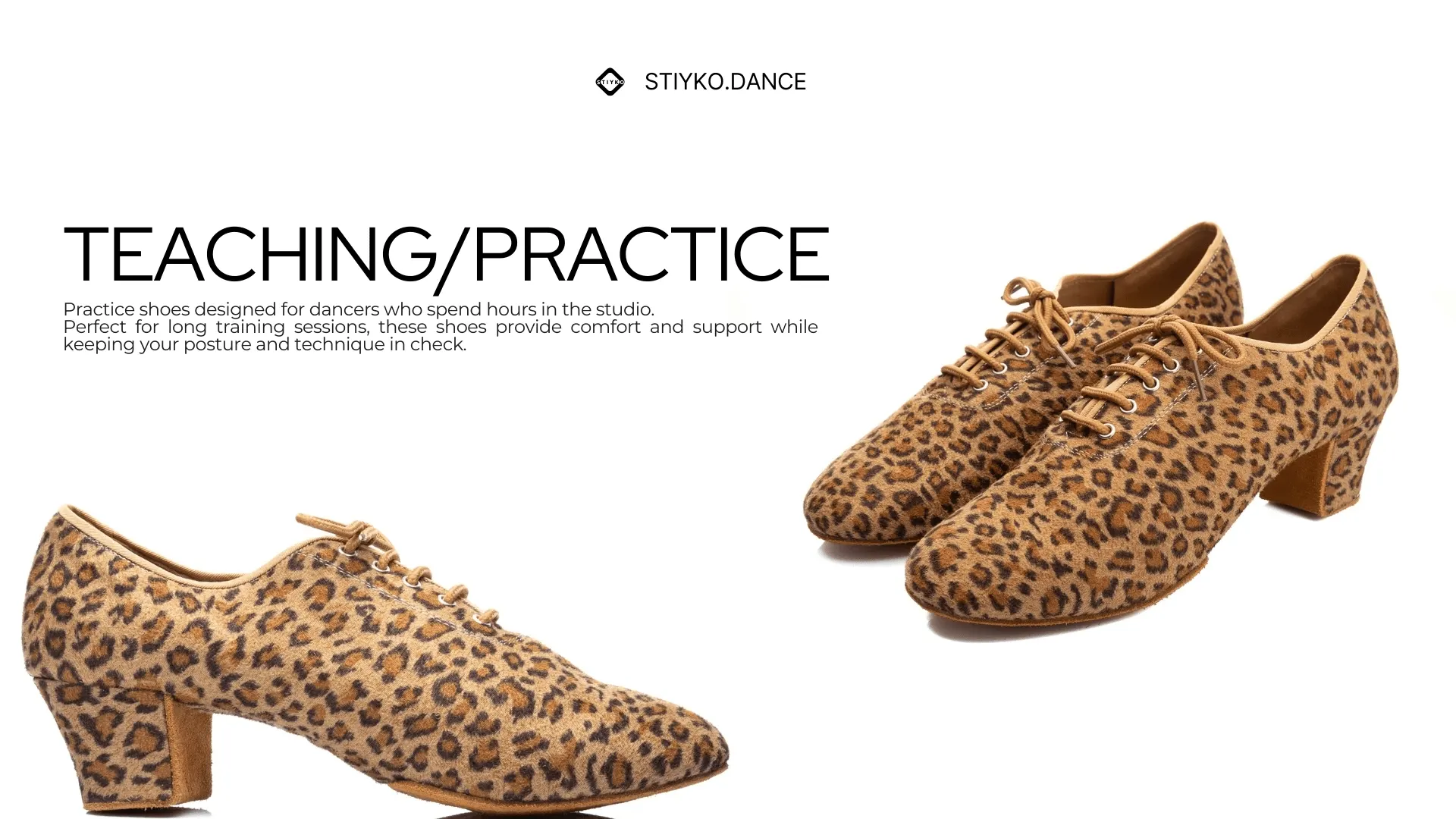
- Your first classes, or social dancing. Buy practice shoes. A low, stable heel and a closed construction will carry you through months of training, and nothing about a competition shoe helps you yet.
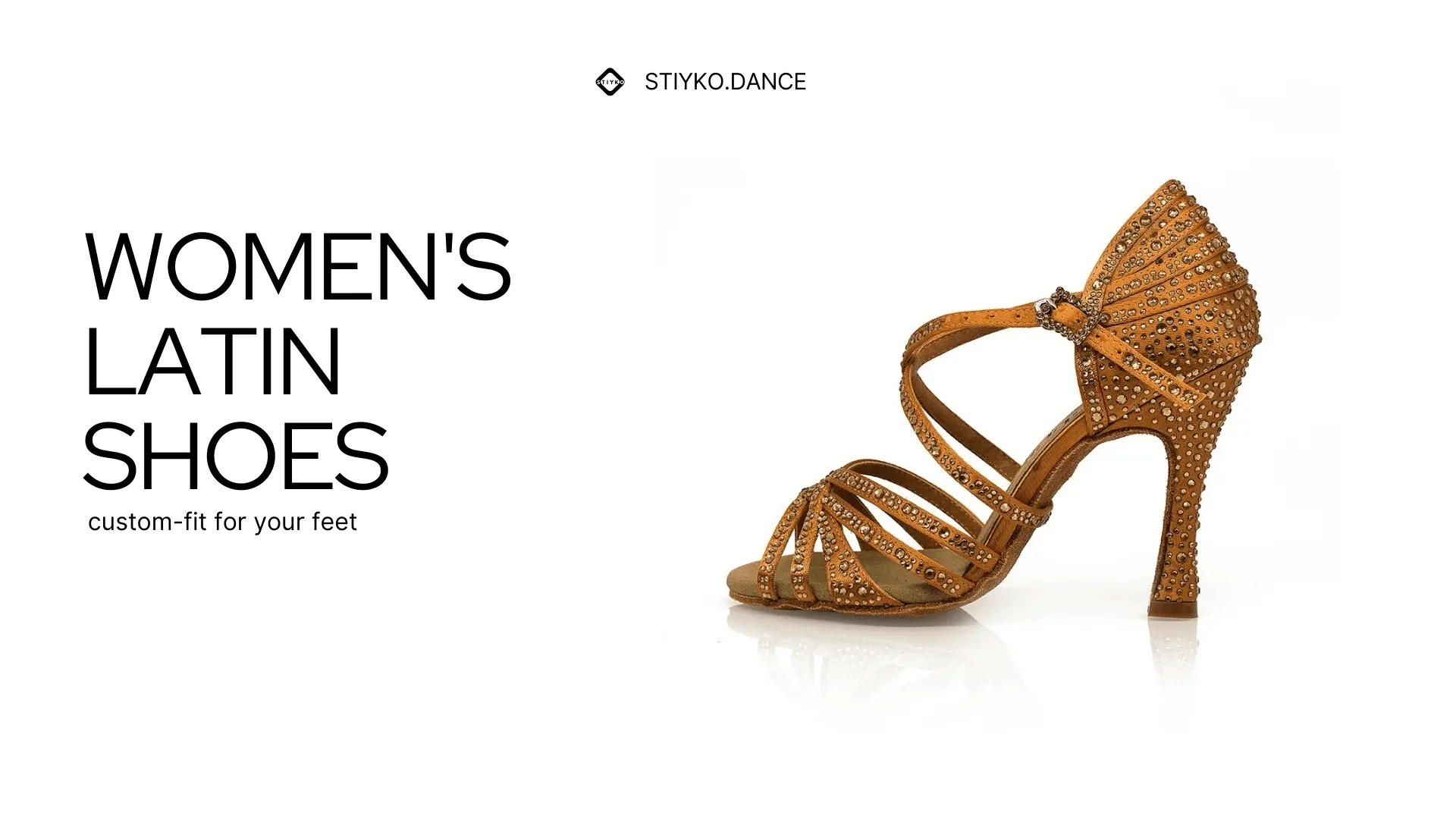
- You have joined a Latin group and will compete. Buy Latin shoes — open sandal, flared heel, split sole.
- You dance Standard. Buy Standard shoes — closed toe, a different heel, a more structured sole.
- You dance both programmes. You need two pairs. One pair cannot do both jobs well, and trying costs you technique in whichever programme loses out.
- You are buying for a child. Start with the kids' range and read the parent's guide — the sizing rules are different, because the foot is still growing.
The Four Types, Side by Side
| Heel | Sole | Upper | Buy it when | |
|---|---|---|---|---|
| Latin | 5.5–9 cm, flared or slim | Fully split suede | Open sandal, straps | Cha-Cha, Samba, Rumba, Jive, Paso |
| Standard | 5–7 cm, broader base | Structured suede | Closed toe, satin or leather | Waltz, Tango, Foxtrot, Quickstep |
| Practice | 2–5 cm, low and stable | Suede, cushioned | Closed, hard-wearing | First classes and every training session |
| Kids | Flat to 5 cm by age | Flexible suede | Secure strap or buckle | A growing foot, any programme |
If the Latin and Standard columns look close on paper but you want the real mechanics — why the heel is placed differently and what that does to your weight — that comparison is its own guide: Latin vs Standard dance shoes. The practice-versus-competition decision has one too: practice shoes vs performance shoes.
Getting the Size Right
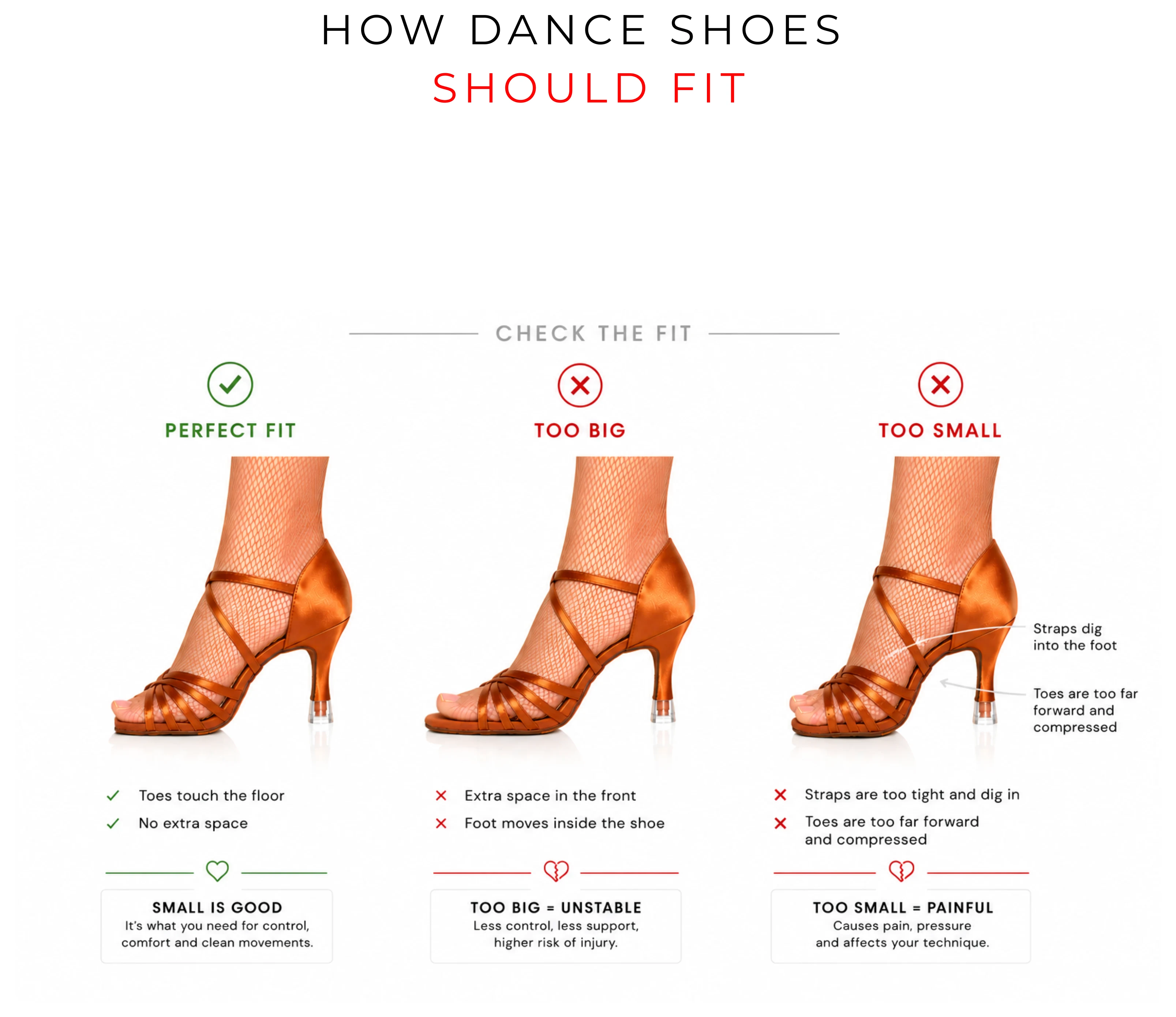
Size is the decision that ruins the most pairs, and it is not the number from your street shoes. A dance shoe is fitted to the foot itself: length, width and shape, measured barefoot, then matched to the specific model.
Most dancers end up roughly half a size to a full size below their everyday number, because leather and satin stretch to the foot over the first few sessions. Only "roughly", though — there is a right way to measure and a set of mistakes worth avoiding, and both are covered in how to measure your foot and choose the size. If you need to convert between EU, UK, US and centimetres, use the size chart; if your foot is wide, narrow or square-fronted, toe shape matters as much as length.
Heel Height and Heel Shape
Two separate choices get confused here: how high the heel is, and what shape it is. Height sets how far forward your weight sits; shape sets how stable it feels once it is there.
| Heel height | Typically suits |
|---|---|
| 5–5.5 cm | Beginners, children, and long training sessions |
| 6–6.5 cm | The most popular everyday competition range |
| 7–7.5 cm | Classic Latin competition height for a trained foot |
| 8–10 cm | Experienced competitors with the ankle strength for it |
| Men: 2–2.5 cm / 3–4.5 cm | Standard / Latin respectively |
A higher heel lengthens the leg line but demands more foot strength and balance — it is not an upgrade, it is a different tool.
Slim
The classic narrow heel: elegant, versatile, the most common shape on Latin shoes.
Flare
Widens towards the floor for a bigger contact patch and noticeably more stability — the usual recommendation for beginners.
Contour
A modern shaped heel that sits between the two: close to a slim line, with more support under the weight.
Which one suits your level, your programme and how long you dance is the whole subject of the dance shoe heel guide.
Men's Shoes
Men's shoes split the same way the programmes do: a 3–4.5 cm Cuban heel with a flexible sole for Latin, a low 2–2.5 cm heel with a firmer construction for Standard. Materials are leather or patent rather than satin, and the fit question is the last and the width rather than the strapping. The detail is in the men's ballroom and Latin shoe guide.
Children's Shoes
The one rule that matters: never buy a size up to grow into. Extra room inside stops a child controlling the foot, which is exactly what these years of training are building. Beyond that it is light weight, a flexible sole, a secure strap and a re-check of the fit every few months. The full picture — when a first real pair is needed, what girls and boys wear, how often you will be replacing them — is in the parent's guide.
Making a Pair Last
A pair that is looked after lasts a season instead of a term. Brush the suede sole, air the shoes after every session, never wear them outdoors, and replace heel tips before they wear through to the metal. Breaking in a new pair without blisters and cleaning each material correctly are covered in how to break in and care for dance shoes; when you are not sure whether an older pair is still safe to dance in, run the five-point safety checklist and read up on heel protectors.
Buying Online Without Trying Them On
Most of our customers order without ever putting the shoe on first, and it works — provided you send the right information instead of a size number. Measure both feet barefoot, at the end of the day, and tell us the length in centimetres, the width at the widest point, which programme you dance and how long you have been dancing.
With that we can match you to a specific model rather than a size, which is the whole difference between a pair that fits and a pair that goes back. Browse Latin, Standard, practice and children's shoes, or see everything in the catalogue.