Contents
Dance shoe sizes are marked in EU, UK or US depending on the brand, and none of them match the street-shoe size printed on your everyday sneakers. Before you order, use the chart below to convert your size — or jump straight to the Latin or Standard collection if you already know it.
Why Dance Shoe Sizes Don't Match Your Street Shoes
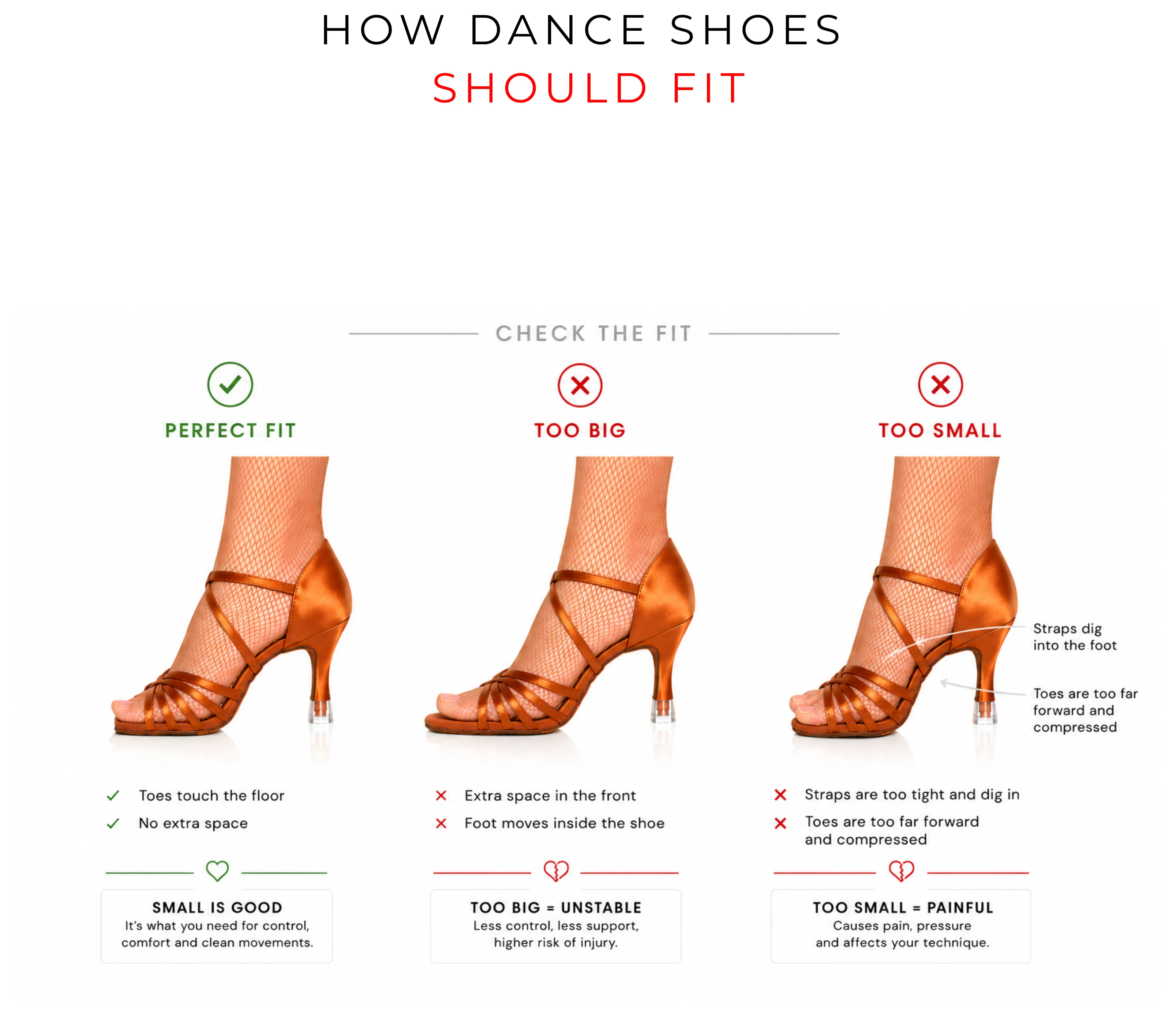
Dance shoes are cut narrower and snugger than everyday footwear on purpose — a loose shoe slides on turns and breaks your line. That tighter last means a size that feels right in a sneaker often runs large in a dance shoe, and manufacturers label the result on whichever scale (EU, UK or US) their factory uses, not necessarily the one you're used to. The chart below lines all of them up against the one measurement that never changes: your foot length in centimetres.
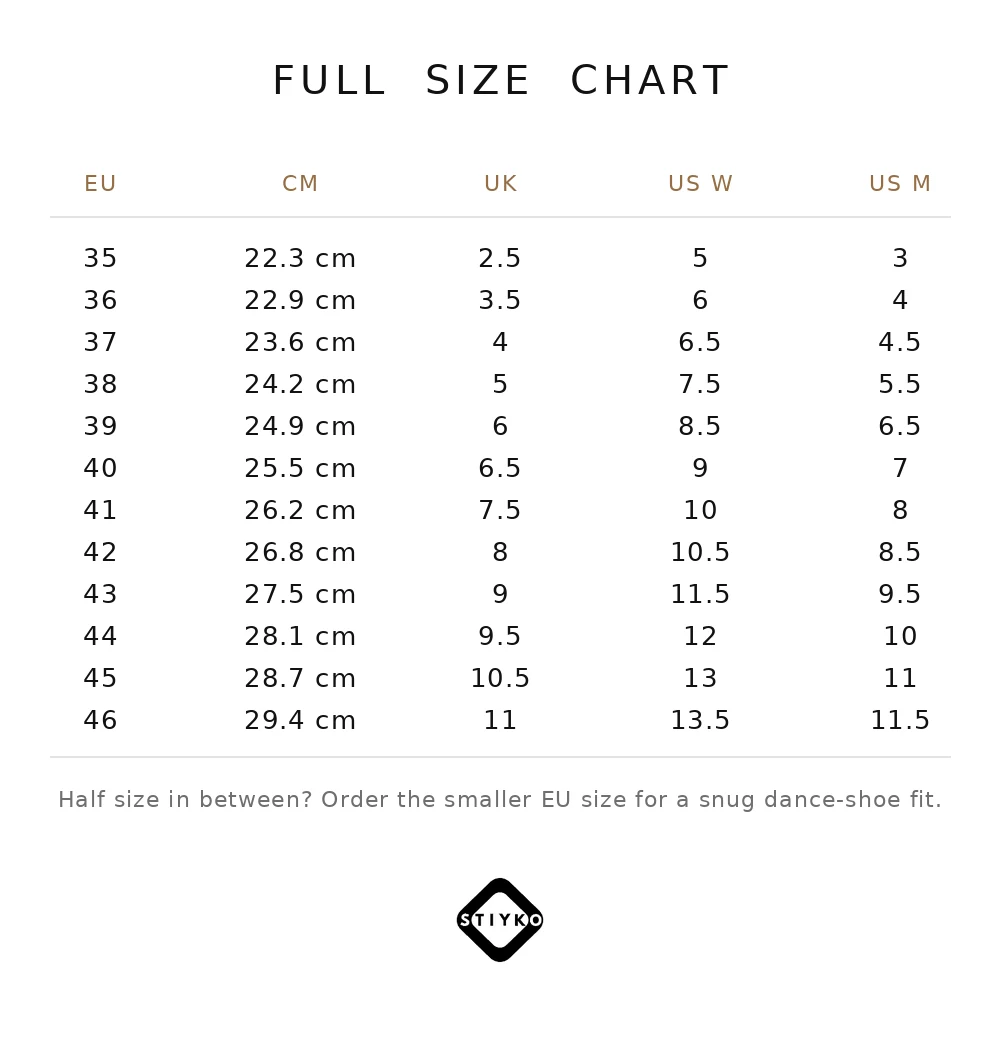
Full EU, UK, US & CM Conversion Chart
Measure your foot length first — see our foot measuring guide if you haven't already — then find the closest centimetre value below.
| Foot length (cm) | EU | UK | US Women | US Men |
|---|---|---|---|---|
| 22.3 | 35 | 2.5 | 5 | 3 |
| 22.9 | 36 | 3.5 | 6 | 4 |
| 23.6 | 37 | 4 | 6.5 | 4.5 |
| 24.2 | 38 | 5 | 7.5 | 5.5 |
| 24.9 | 39 | 6 | 8.5 | 6.5 |
| 25.5 | 40 | 6.5 | 9 | 7 |
| 26.2 | 41 | 7.5 | 10 | 8 |
| 26.8 | 42 | 8 | 10.5 | 8.5 |
| 27.5 | 43 | 9 | 11.5 | 9.5 |
| 28.1 | 44 | 9.5 | 12 | 10 |
| 28.7 | 45 | 10.5 | 13 | 11 |
| 29.4 | 46 | 11 | 13.5 | 11.5 |
Read the chart from the centimetre column, not from the size you usually buy. Measure both feet barefoot at the end of the day, when the foot is at its largest, take the longer of the two, and find the closest cm value — the EU, UK and US columns follow from it. Working the other way round, from a street-shoe number, is how most sizing mistakes start.
Treat the result as a starting point rather than a verdict. This is a multi-brand chart, and a last cut narrow, a stiff patent upper or a wide forefoot can each move you a half size — which is why we ask for a width measurement alongside the length before an order goes out.
Women's vs Men's Sizing
The same EU size maps to two different US numbers depending on gender — EU 39 is a US women's 8.5 but a US men's 6.5, for example. Always check whether a listing quotes US women's or US men's before you convert, and when in doubt, order by EU size or centimetres, since those don't change with gender.
What to Do Between Sizes
If your foot length falls between two rows, size down rather than up. Dance shoes are meant to fit snugly — with almost no room to slide inside — so a slightly smaller size supports the foot properly through turns, while a slightly larger one lets the heel lift and the foot slip forward. Suede soles also relax and mould to the foot within the first few wears, which makes a snug fit at purchase the right call, not a mistake.
Children's Sizes Run on a Separate Chart
Children's feet fall below EU 35, on a different part of the same cm-based scale (EU 26 to 34, roughly a 16.5–21.6 cm foot). We've kept that range in a dedicated chart in our kids' ballroom shoe guide, including how often to size up as a child grows.
Measuring Your Foot First
Every size in this chart starts from a foot-length measurement in centimetres, so an accurate measurement matters more than any size label. Our guide to measuring your foot covers how to measure both length and width correctly, in the evening when your foot is at its largest.
Frequently Asked Questions
Is EU 38 the same as US 7?
Close, but check which US scale is quoted: EU 38 converts to a US women's 7.5 or a US men's 5.5 — not a plain "US 7" on its own. When a listing doesn't specify, use the centimetre value instead.
Should I size up if I normally wear a wide shoe?
Not usually — sizing up to fix width makes the shoe too long and lets the foot slide, which is worse for dancing than a slightly snug width. See our foot measuring guide for width-specific advice and check each model's description for wide-fit notes.
Do all brands use the same size chart?
The EU-to-centimetre relationship is close to universal, but exact fit still varies a little by brand and last. Treat this chart as your starting size and fine-tune from the description and reviews of the specific model.
What size are children's dance shoes?
Children's sizes run EU 26 to 34 (about 16.5–21.6 cm) — below the adult chart on this page. See our kids' ballroom shoe guide for the full children's chart.