Contents
- Why Foot Shape Matters When Choosing Dance Shoes
- Square Toe Ballroom Shoes: Which Foot Shape Fits Best?
- Round Toe Ballroom Shoes: Which Foot Shape Fits Best?
- Round Toe vs Square Toe: The Simple Rule
- How Should Ballroom Shoes Fit — and How to Check
- When the Size Is Right but the Shape Is Wrong
- Latin and Standard Shoes: Why Toe Shape Matters Differently
- Children's Ballroom Shoes: Toe Shape and Room to Grow
- Comfortable Dance Shoes for Long Practice Sessions
- How to Choose Dance Shoes Online
- We'll Help You Find the Right Shape
- Frequently Asked Questions
Choosing ballroom dance shoes does not start and end with the size. Heel height, material, sole type and the dance programme all matter — but one of the most important factors is also the most overlooked: the shape of the front of your foot.
Why does one pair of dance shoes fit perfectly while another presses on the toes, even when the size is correct? The reason may not be the length of your foot at all. It may be the shape of the toe box.
Round and square toe boxes interact differently with the natural line of your toes. That is why, whether you are choosing children's or adult ballroom dance shoes, it is worth considering not only the size but the natural shape of the foot. A well-chosen pair should follow the natural line of the foot and give you stability, control and comfort through training and performance.
Why Foot Shape Matters When Choosing Dance Shoes
Every foot is different. Some dancers have toes that sit almost in one line, forming a squarer front to the foot. Others have toes that gradually shorten, creating a smooth, rounded line. Two dancers wearing exactly the same shoe size can need completely different shoe shapes.
When the toe box does not match the natural shape of your foot, you may get:
- pressure on the toes
- discomfort during long training sessions
- rubbing
- a squeezed, compressed feeling
- too much empty space at the front
- an unstable foot
- weight that is not distributed evenly
So before you buy ballroom dance shoes, it is worth assessing more than the length of your foot — look at the line your toes make. Makers of professional dance shoes build different lasts for exactly this reason: forefoot width and toe-box shape vary between models as much as heel heights do.
If you have not measured yet, start there: how to measure your foot for the right dance shoe size covers length and width first, and shape comes next.
Square Toe Ballroom Shoes: Which Foot Shape Fits Best?
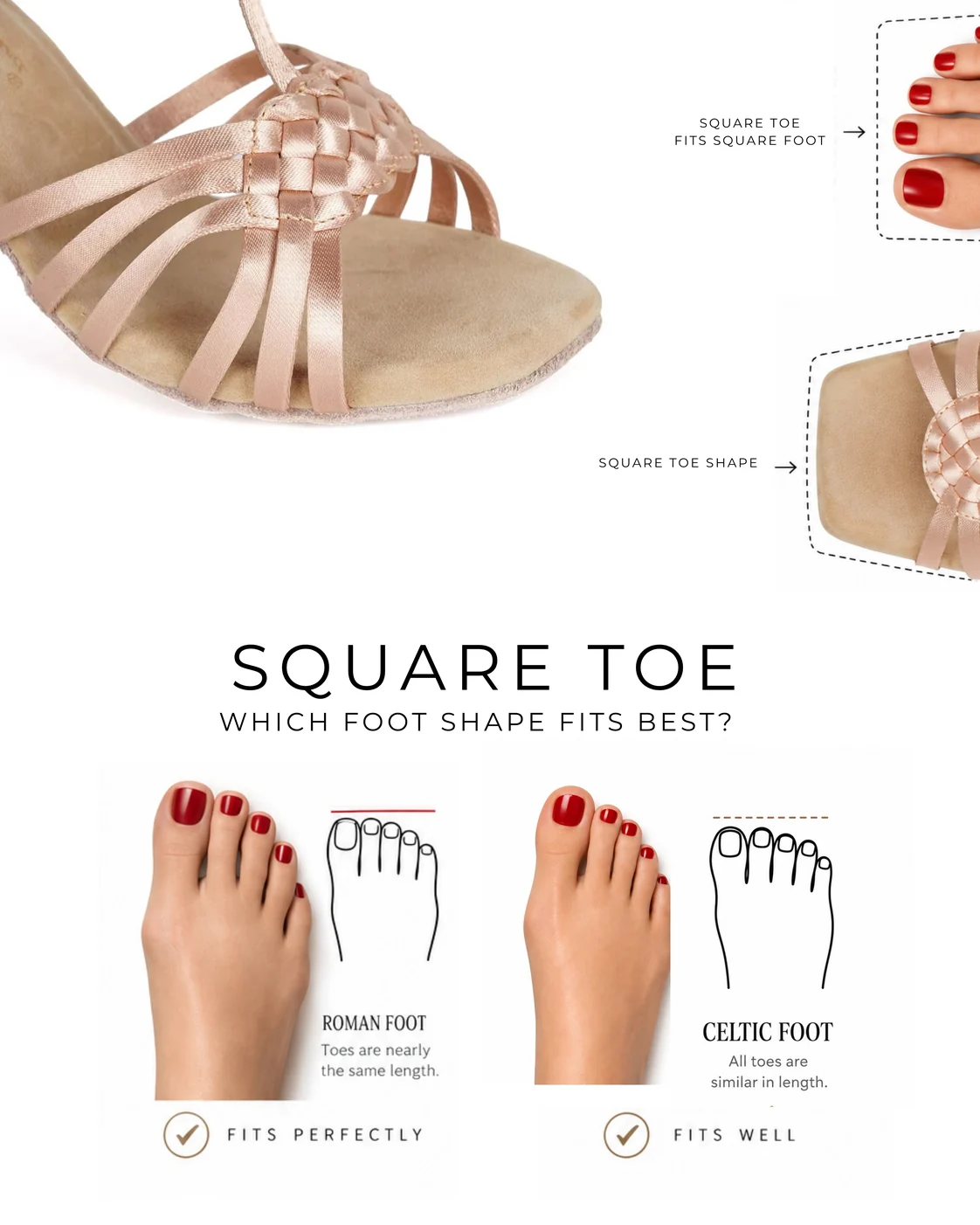
A square toe box has a straighter, wider line across the front of the shoe. It tends to suit dancers whose first few toes are close to the same length — the two foot shapes shown in the chart at the top of this page.
Roman foot
A Roman foot has the first toes at almost the same length, so the front of the foot forms a nearly straight line. A square front can follow that line closely, which is why a Roman foot usually fits a square toe box perfectly.
Celtic foot
With a Celtic foot all the toes are similar in length, again giving a relatively even line across the forefoot. For many dancers with this shape a square front gives the toes a more natural position than a narrow rounded one.
A square toe may suit you if:
- your forefoot is naturally broad
- your toes sit almost in one line
- several toes are similar in length
- rounded models press on the sides of your foot
- narrow or pointed shoes create pressure across the front
A square toe box does not automatically mean a loose shoe. It should still hold the foot securely — the only difference is the line across the front. The main rule stays the same: the shoe should not leave a lot of empty space, and it should not squeeze the toes. That is why individual forefoot width matters just as much when you are choosing women's Latin dance shoes, Standard ballroom shoes or children's ballroom shoes.
Round Toe Ballroom Shoes: Which Foot Shape Fits Best?
A round toe box has a softer, curved line at the front. It tends to suit a foot where the toes gradually shorten, creating a naturally tapered silhouette.
Germanic foot
In a Germanic foot the big toe is the longest and the others gradually shorten, forming a smooth descending line. A rounded front follows that contour closely — this is the shape a round toe box fits perfectly.
Greek foot
In a Greek foot the second toe is the longest, so the toe line peaks slightly instead of running straight. A rounded front usually accommodates that peak well, which is why a Greek foot generally fits a round toe box too.
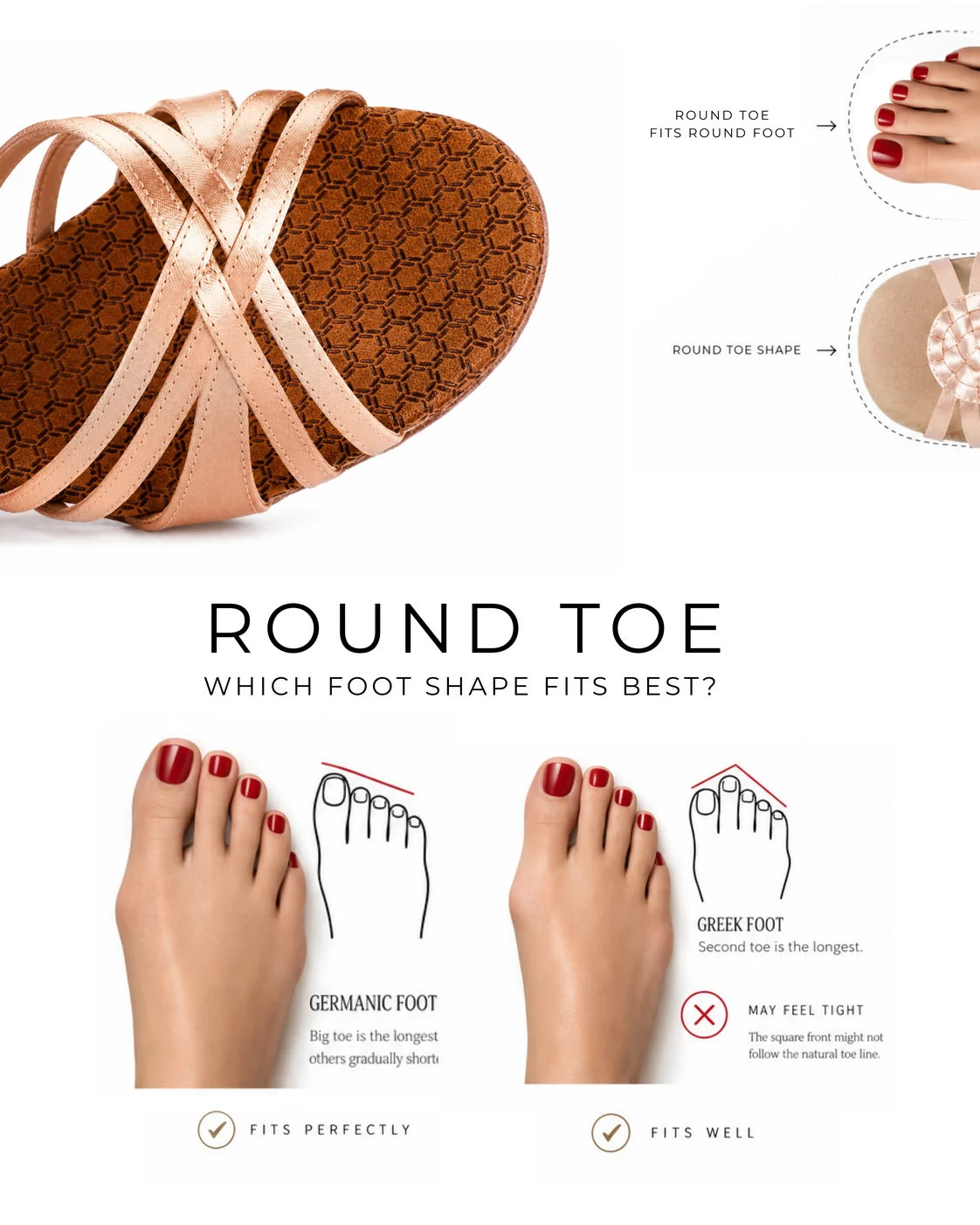
A round toe may be comfortable if:
- your toes gradually shorten toward the little toe
- your foot has a naturally rounded or tapered shape
- your forefoot does not need extra width
- a square front feels too wide around the sides
But it is important to remember that the name of the foot type matters less than how naturally your toes sit inside the shoe. There is no universal toe shape that suits everyone. The best dance shoes are not simply the most fashionable or most popular model — they are the ones that match the shape of your particular foot.
Round Toe vs Square Toe: The Simple Rule
- Square toe — better for a straighter toe line, when several toes are a similar length (Roman and Celtic feet).
- Round toe — better for a curved, tapered toe line, when the toes gradually shorten (Germanic and Greek feet).
How Should Ballroom Shoes Fit — and How to Check
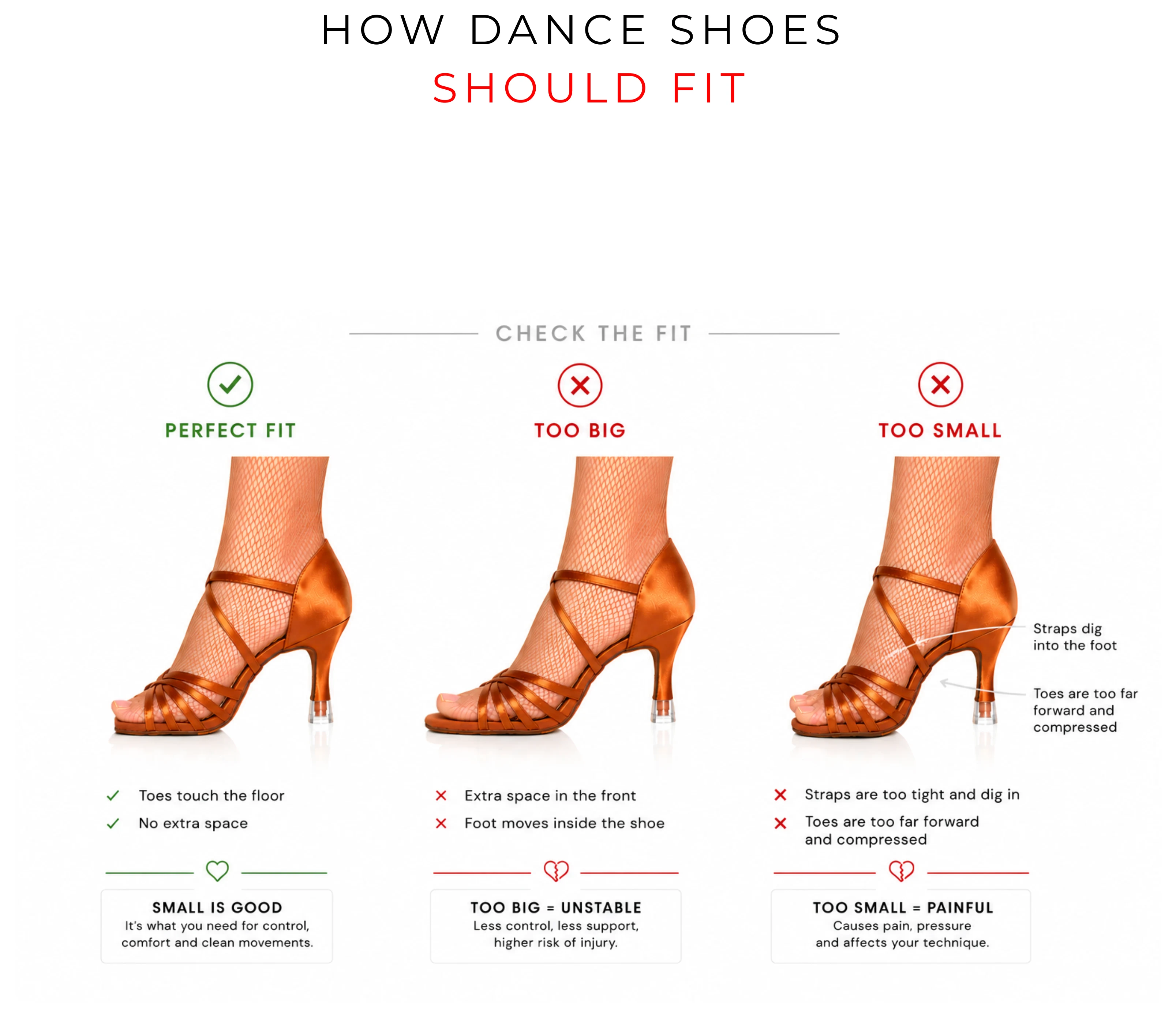
Ballroom dance shoes should fit much closer to the foot than everyday shoes. The foot should feel secure inside the shoe, with no unnecessary empty space around the toes, the sides or the heel. But snug does not mean painful. A properly fitted pair should hold the foot securely, minimise sliding inside the shoe, keep the heel stable, let the toes take a natural position, and neither rub nor leave a lot of free space.
Do not judge a dance shoe standing still — dance shoes are made for movement. Try this:
- Stand naturally. Your toes should not feel painfully compressed.
- Transfer your weight forward. Check whether the foot slides forward inside the shoe.
- Point your foot. The shoe should keep following the foot instead of opening up empty space.
- Check the heel. It should feel secure, without lifting away from the shoe.
- Look at the toe line. Ask yourself: does the front of the shoe follow the natural shape of my toes?
That last question is the one that tells you whether a round or a square toe box is right for you. For more on length and the snug-fit rule, see how to choose the right Latin dance shoe size.
When the Size Is Right but the Shape Is Wrong
Sometimes the problem is not the size. If the length of the shoe is correct and you still feel constant pressure across the front of the foot, the cause may be a mismatch in toe shape. Put a naturally broad, straight forefoot into a narrow rounded shoe and the toes will feel compressed even though the length is right. The opposite happens too: a narrower, tapered foot can feel unstable inside an excessively wide square front.
Watch for these signals:
- the toes are noticeably squeezed together
- pressure comes from one side only
- there is too much space between the toes and the front of the shoe
- the foot slides forward
- the front of the shoe does not follow the natural line of your toes
In that case, do not rush to take a bigger size — a larger shoe only adds empty space and reduces control. What you probably need is a different last or a different toe shape. Over a long session small mismatches become far more noticeable, because repeated movement concentrates pressure exactly where the fit is already poor.
Latin and Standard Shoes: Why Toe Shape Matters Differently
One of the most common mistakes is assuming that any ballroom shoe works equally well for every programme. In reality, shoes for Latin and shoes for Standard are built for different jobs, and the front of the foot is loaded differently in each.
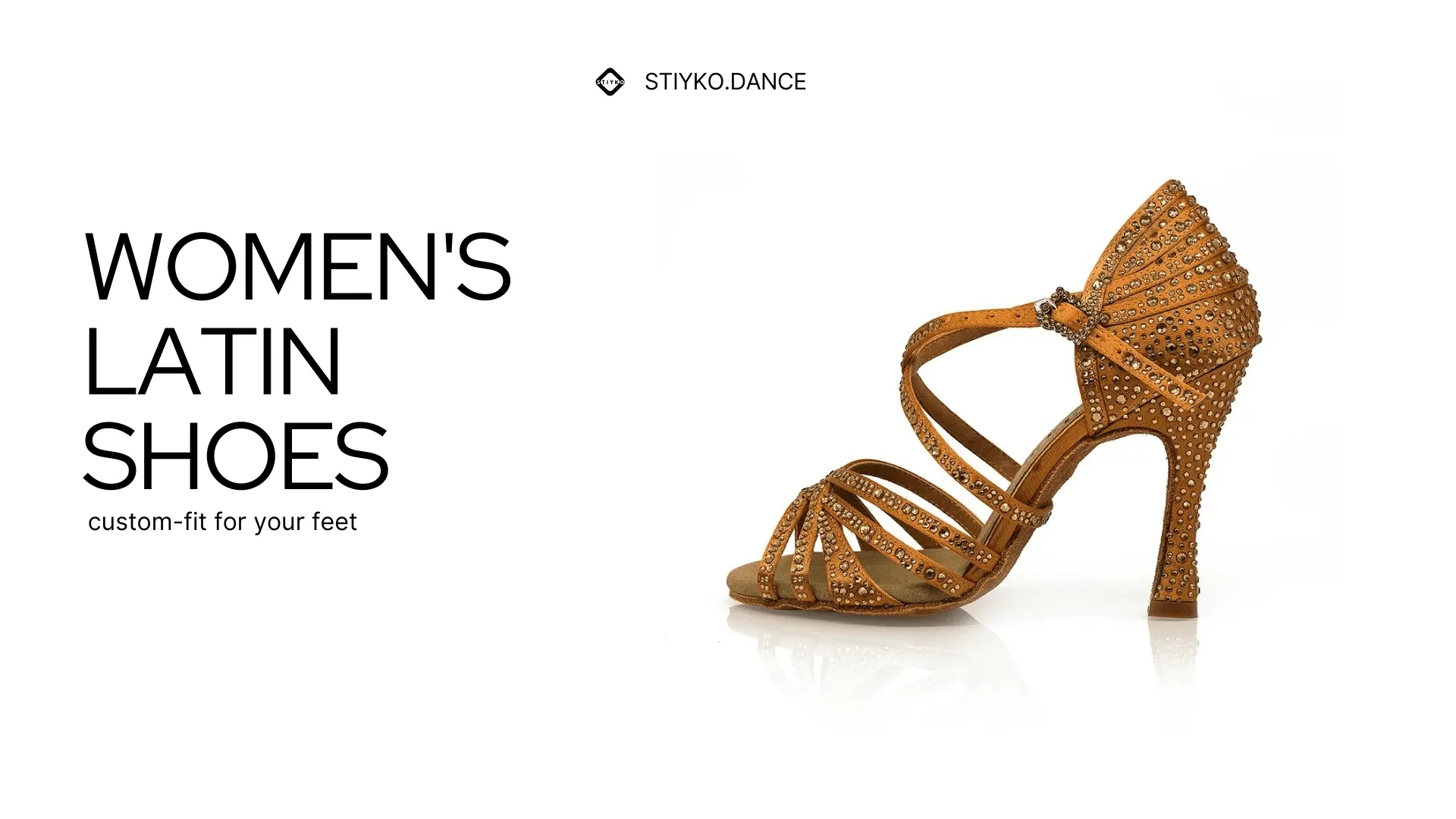
For the Latin American programme what matters is flexibility of the foot, mobility, correct work through the toes, stability on the heel and secure fastening. Women's Latin shoes often have an open construction with various strap arrangements — which is exactly why the shape of the forefoot matters so much here: there is less material to disguise a mismatch. Browse women's Latin dance shoes.
Shoes for the European (Standard) programme are built differently: a closed construction, stability, proper support for the foot, comfort moving from the heel, a precise fit and secure fastening. Women's Standard shoes enclose the whole foot, so length, width and toe shape all have to agree with each other. Browse Standard ballroom shoes.
This is why specialist shops list Latin and Standard separately: women's Latin, women's Standard, men's shoes and children's models are genuinely different constructions, not just different labels. Heel construction differs between them too — see choosing dance shoe heel height and shape.
Children's Ballroom Shoes: Toe Shape and Room to Grow
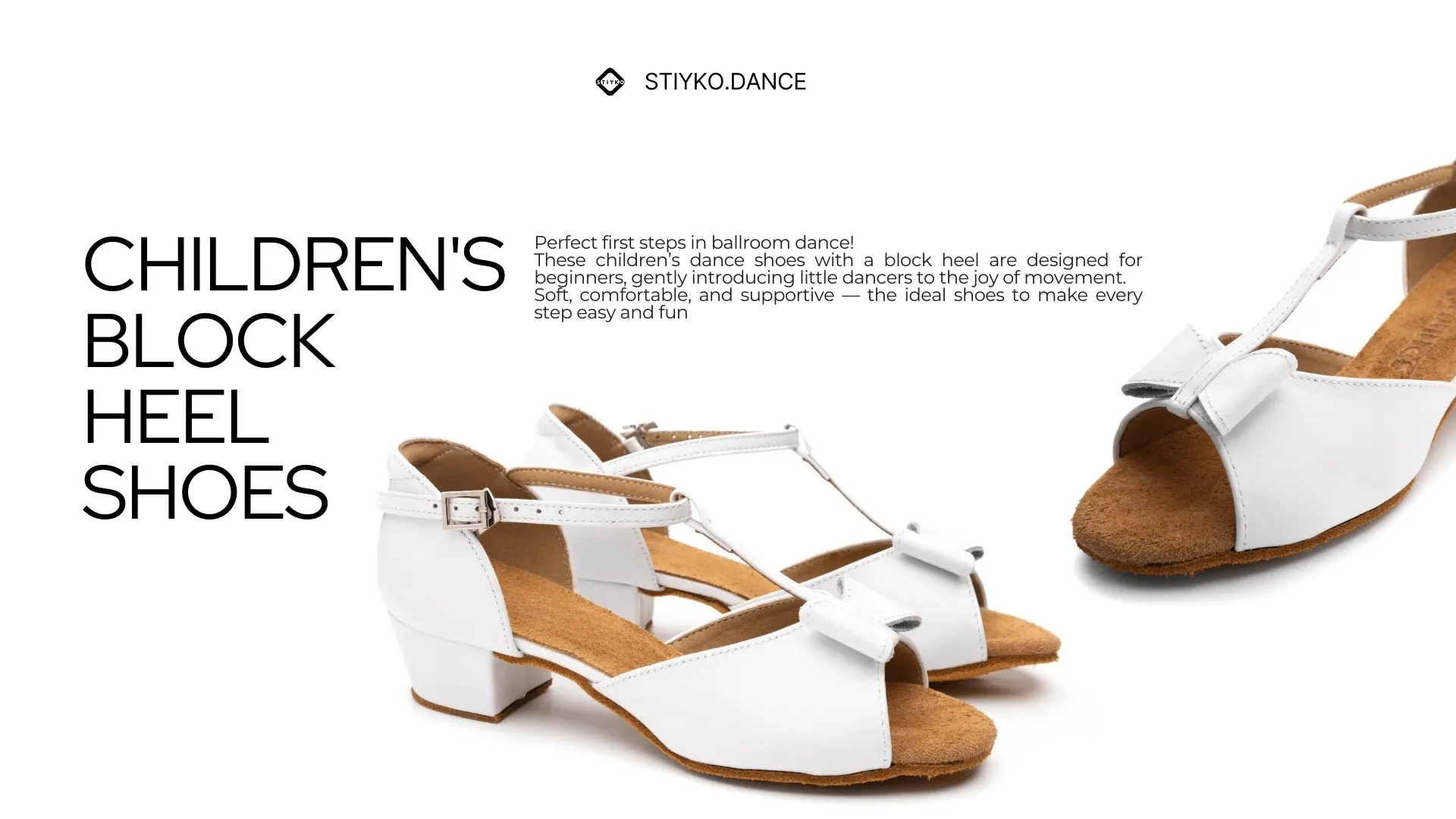
Choosing children's ballroom dance shoes needs particular care. A child's foot grows, so parents often want to buy shoes with room to spare. For dancing, though, a pair that is too big works against the child: the foot slides inside the shoe, stability drops and technique suffers.
Children's dance shoes for a girl or a boy should:
- match the actual size of the foot
- hold the foot securely
- not slide
- not press on the toes
- suit the dance programme
- keep the foot stable through movement
Toe shape matters here too — often more than with adults. Children's feet are usually broader across the toes and the toe line is more even, so a square front frequently follows a child's forefoot better than a narrow rounded one. Whether you are looking for children's Latin shoes, children's Standard shoes, or a first pair of ballroom shoes for a girl, check the width across the toes as carefully as the length. Browse children's ballroom dance shoes.
Comfortable Dance Shoes for Long Practice Sessions
The most comfortable dance shoes for long practice sessions are not simply the softest ones. Comfort across two or three hours depends on several things at once:
- the correct size
- the correct width
- toe shape
- a secure heel
- a flexible sole
- an appropriate heel height
- support that suits the individual dancer
- quality materials
- how often you train
A shoe that feels comfortable for five minutes in a shop can feel completely different after two hours of dancing. Too loose feels comfortable at first but causes instability through turns and weight changes; too tight feels secure but builds painful pressure over time. The balance you want is: secure, flexible, close-fitting, comfortable.
There is no single model that is universally the most comfortable — it depends on your dance style, your foot anatomy, how long you train, and how the shoe distributes pressure and holds the foot while you move. Dancers who practise several times a week notice a small fitting problem far sooner than occasional dancers, so the more you dance, the more it pays to get the shape right as well as the size.
How to Choose Dance Shoes Online
If you plan to buy ballroom dance shoes online, measure three things before ordering:
- Foot length — from the heel to the longest toe.
- Foot width — at the widest part of the forefoot.
- Forefoot shape — do your toes form an even line? Is the big toe clearly the longest? Is the second toe the longest? Is the front of the foot rounded?
Those three answers are what actually determine the right last. It is also worth deciding, before you order: which programme do you need the shoes for — Latin or Standard? Is your foot more rounded or more square? Is it narrow, medium or wide? How often do you train? And what level are you dancing at — beginner, experienced dancer or professional?
We'll Help You Find the Right Shape
There is no single perfect model for everyone — even the most expensive and most popular dance shoes may not suit a particular foot. Send us your foot length, your foot width and a photo of your foot from above, tell us whether you dance Latin or Standard and whether the shoes are for an adult or a child, and we will suggest models whose toe box matches your foot. Browse Latin dance shoes, Standard ballroom shoes and children's dance shoes, or see the full catalog. We ship across Ukraine and internationally, including to dancers in Lithuania, Israel and across Europe.
Frequently Asked Questions
How should ballroom shoes fit?
Ballroom shoes should fit snugly and securely, without painful pressure. Consider foot length and width, the shape of your toes, the programme you dance — Latin or Standard — and also your level and how often you train. The foot should not slide excessively inside the shoe, and the heel should stay stable through movement.
Are ballroom dance shoes supposed to be tight?
They should feel closer to the foot than everyday shoes, but they should never cause sharp pain, numbness or excessive compression. Snug is correct; painful is not.
Which is better: a round or a square toe?
It depends entirely on your foot shape. A square toe may suit a straighter toe line, where several toes are a similar length, while a round toe may suit a foot with a smoother, more tapered line.
Are round toe dance shoes more comfortable?
Not necessarily. Round toe shoes are more comfortable for dancers whose foot naturally follows a rounded or tapered line — a Germanic or Greek foot. For a broad, straight forefoot they can feel tight.
Are square toe dance shoes better for wide feet?
A square toe can give additional space across the front of the foot, but width and toe shape should always be assessed separately — a wide foot with a strongly tapered toe line may still fit a rounded front better.
What are the most comfortable dance shoes for long practice sessions?
The most comfortable dance shoes for long practice sessions are the ones that match your foot shape, width, dance style, heel preference and training load. There is no single universally most comfortable model.
How do I choose ballroom shoes for my foot shape?
Look at the natural outline of your toes and forefoot, then choose a shoe shape that follows your foot rather than forcing your toes into an unnatural position. Measure length and width first, then match the toe box.
Should children's ballroom shoes be bought a size up?
Too much room makes it harder to hold the foot in place. Children's dance shoes should sit stably and not let the foot slide inside — buy to the current size of the foot, not to next season's.
How do Latin and Standard shoes differ?
They differ in construction, flexibility, shape and purpose. Latin shoes are usually open and more flexible; Standard shoes are closed and built for stability and support. Each programme uses shoes designed specifically for it.
How do I pick the right children's ballroom shoes?
Measure the length and the width of the foot, take the dance programme into account, and choose a model that holds the foot securely without pressing on the toes. Check the width across the toes as carefully as the length.